About Get3DMed
Study anatomy and biology in the shape they actually take.
Get3DMed is a 3D atlas that runs in your browser, from the whole body down to cells, tissues with real microscope slides, embryos, disease, microbes and plants, with the molecules alongside. Turn a model, peel back its layers, slice through it and select any structure to see what it is.
- What
- Labelled 3D models from the body to the cell, real slides and molecules, with an AI tutor beside the model.
- Where
- In your browser. Nothing to install and no account needed to explore; a free account keeps your views, notes and place in every model.
- Who for
- Medical students, wherever they study.
In the viewer
See where everything sits.
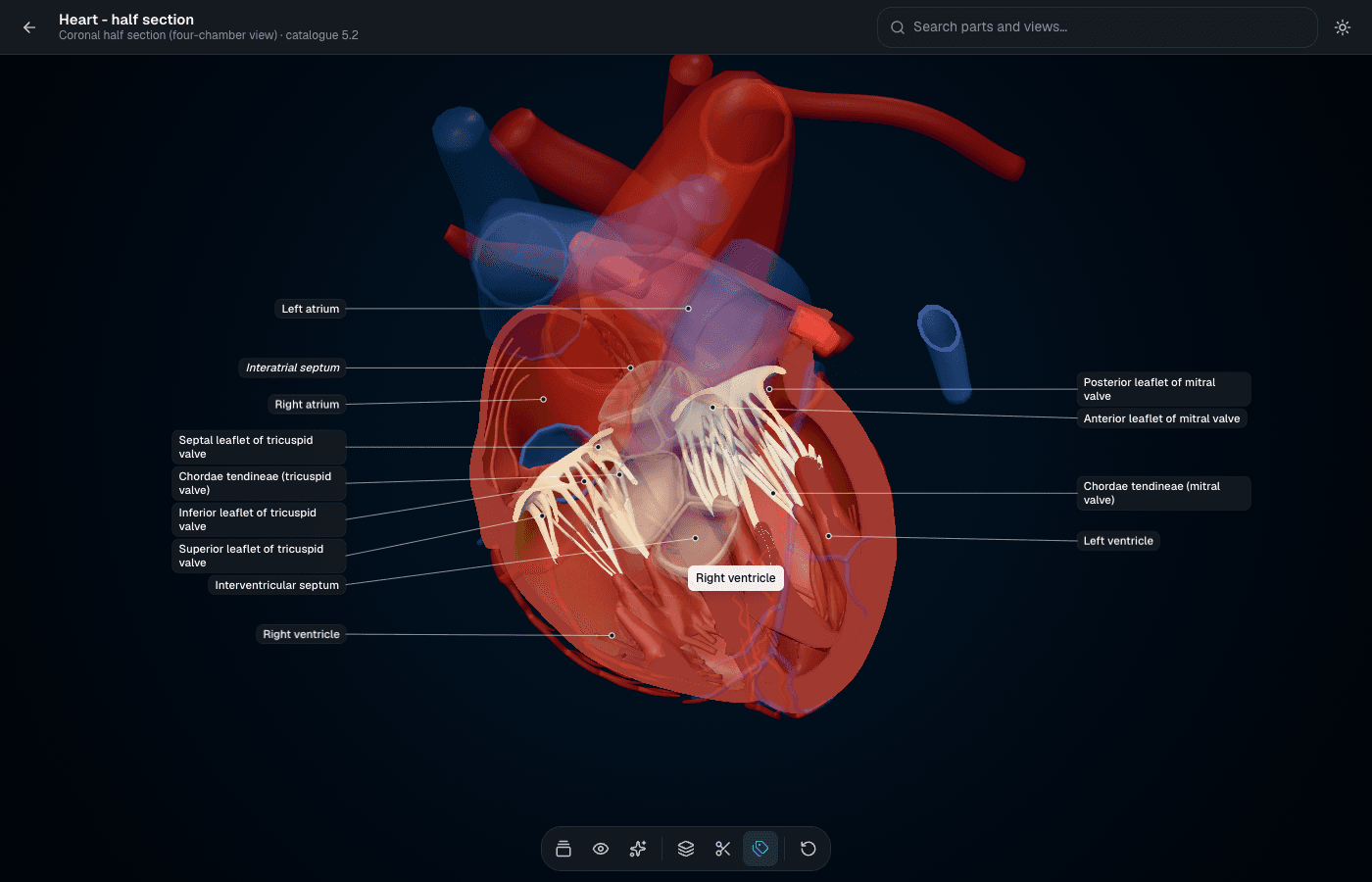
Anatomy asks you to understand where things sit and how they connect. Select a name and its structure lights up; turn the model to see what surrounds it. Keep your course notes beside it.
Search parts and views
Find a structure by name or synonym.
Textbook views
Open prepared angles and sections.
Layers and isolation
Peel back, hide or isolate anatomy.
Cross-sections
Slice supported models at any depth.
Linked labels
Select a name to highlight its part.
AI tutor
Ask about what’s in front of you.
Microscope slides
Compare the model with a real slide.
Look closer
Go from an organ to its cells.
Saved views
Keep an arrangement and reopen it anywhere.
Your notes
Write your own notes on any structure.
What the atlas covers
93 models and 4,006 labelled parts, from the whole body to the cell.
Each model is built from labelled parts tagged by body system. The table groups the models by topic and counts their parts in each system and their real microscope slides. Select a model to open it.
| Model | Skeletal | Joints | Muscles | Cardio | Nervous | Resp. | Digestive | Urinary | Repro. | Endocrine | Lymphatic | Skin | Cells | Slides | Parts |
|---|---|---|---|---|---|---|---|---|---|---|---|---|---|---|---|
| Human anatomy 23 models | |||||||||||||||
| 01Heart | 0 | 0 | 0 | 54 | 0 | 0 | 0 | 0 | 0 | 0 | 0 | 0 | 0 | 0 | 54 |
| 02Upper limb | 37 | 35 | 52 | 26 | 29 | 0 | 0 | 0 | 0 | 0 | 0 | 15 | 0 | 0 | 194 |
| 03Lower limb and pelvis | 37 | 66 | 67 | 36 | 20 | 0 | 0 | 0 | 0 | 0 | 3 | 20 | 0 | 0 | 249 |
| 04Thorax | 65 | 12 | 14 | 39 | 7 | 17 | 1 | 0 | 0 | 0 | 9 | 10 | 0 | 0 | 174 |
| 05Abdomen | 15 | 3 | 29 | 56 | 9 | 0 | 28 | 7 | 0 | 2 | 8 | 10 | 0 | 0 | 167 |
| 06Male pelvis | 7 | 12 | 42 | 31 | 11 | 0 | 6 | 6 | 13 | 0 | 4 | 8 | 0 | 0 | 140 |
| 07Spine and spinal cord | 31 | 55 | 34 | 1 | 26 | 0 | 0 | 0 | 0 | 0 | 0 | 7 | 0 | 0 | 154 |
| 08Skull | 19 | 7 | 0 | 0 | 0 | 7 | 28 | 0 | 0 | 0 | 0 | 0 | 0 | 0 | 61 |
| 09Head and neck | 16 | 1 | 48 | 29 | 15 | 30 | 13 | 0 | 0 | 2 | 7 | 23 | 0 | 0 | 184 |
| 10Brain and cranial nerves | 5 | 0 | 9 | 32 | 132 | 6 | 1 | 0 | 0 | 3 | 0 | 2 | 0 | 0 | 190 |
| 11Eye and orbit | 8 | 0 | 10 | 5 | 31 | 0 | 0 | 0 | 0 | 0 | 0 | 4 | 0 | 0 | 58 |
| 12Ear | 4 | 0 | 0 | 3 | 6 | 3 | 0 | 0 | 0 | 0 | 0 | 10 | 0 | 0 | 26 |
| 13Skeleton | 208 | 0 | 0 | 0 | 0 | 0 | 1 | 0 | 0 | 0 | 0 | 0 | 0 | 0 | 209 |
| 14Muscles of the body | 8 | 0 | 180 | 0 | 1 | 0 | 0 | 0 | 0 | 0 | 0 | 0 | 0 | 0 | 189 |
| 15Whole body | 17 | 0 | 29 | 69 | 26 | 7 | 19 | 4 | 6 | 5 | 13 | 4 | 0 | 0 | 199 |
| 16Whole body (female) | 19 | 0 | 29 | 67 | 26 | 7 | 19 | 4 | 10 | 5 | 13 | 6 | 0 | 0 | 205 |
| 17Female pelvis | 7 | 11 | 50 | 31 | 11 | 0 | 4 | 4 | 36 | 0 | 4 | 2 | 0 | 0 | 160 |
| 18Breast | 0 | 0 | 0 | 0 | 0 | 0 | 0 | 0 | 8 | 0 | 0 | 9 | 0 | 0 | 17 |
| 19Male and female urethra | 8 | 1 | 0 | 0 | 0 | 0 | 4 | 6 | 9 | 0 | 0 | 0 | 0 | 0 | 28 |
| 28Conduction system of the heart | 0 | 0 | 0 | 18 | 0 | 0 | 0 | 0 | 0 | 0 | 0 | 0 | 0 | 0 | 18 |
| 29Neural pathways | 0 | 0 | 0 | 0 | 35 | 0 | 0 | 0 | 0 | 0 | 0 | 0 | 0 | 0 | 35 |
| 53Permanent teeth | 0 | 0 | 0 | 0 | 0 | 0 | 32 | 0 | 0 | 0 | 0 | 0 | 0 | 0 | 32 |
| 89Dermatomes | 2 | 0 | 0 | 0 | 65 | 0 | 0 | 0 | 0 | 0 | 0 | 0 | 0 | 0 | 67 |
| Microscopic anatomy 24 models | |||||||||||||||
| 20Nephron | 0 | 0 | 0 | 8 | 0 | 0 | 0 | 14 | 0 | 0 | 0 | 0 | 0 | 0 | 22 |
| 21Alveoli | 0 | 0 | 0 | 3 | 0 | 9 | 0 | 0 | 0 | 0 | 0 | 0 | 0 | 0 | 12 |
| 22Intestinal villi | 0 | 0 | 0 | 5 | 0 | 0 | 9 | 0 | 0 | 0 | 2 | 0 | 0 | 0 | 16 |
| 23Skin | 0 | 0 | 0 | 5 | 3 | 0 | 0 | 0 | 0 | 0 | 0 | 17 | 0 | 0 | 25 |
| 25Neurone | 0 | 0 | 2 | 0 | 12 | 0 | 0 | 0 | 0 | 0 | 0 | 0 | 0 | 0 | 14 |
| 26Skeletal muscle structure | 0 | 0 | 18 | 0 | 0 | 0 | 0 | 0 | 0 | 0 | 0 | 0 | 0 | 0 | 18 |
| 27Compact bone and osteons | 9 | 0 | 0 | 2 | 1 | 0 | 0 | 0 | 0 | 0 | 0 | 0 | 0 | 0 | 12 |
| 31Layers of the heart wall | 0 | 0 | 0 | 12 | 0 | 0 | 0 | 0 | 0 | 0 | 0 | 0 | 0 | 0 | 12 |
| 36Layers of the retina | 0 | 0 | 0 | 0 | 19 | 0 | 0 | 0 | 0 | 0 | 0 | 0 | 0 | 1 | 19 |
| 37Cochlear duct and spiral organ | 0 | 0 | 0 | 0 | 22 | 0 | 0 | 0 | 0 | 0 | 0 | 0 | 0 | 1 | 22 |
| 52Structure of a tooth | 0 | 0 | 0 | 0 | 0 | 0 | 10 | 0 | 0 | 0 | 0 | 0 | 0 | 0 | 10 |
| 79Liver lobule | 0 | 0 | 0 | 0 | 0 | 0 | 12 | 0 | 0 | 0 | 0 | 0 | 0 | 1 | 12 |
| 80Wall of the small intestine | 0 | 0 | 0 | 0 | 0 | 0 | 11 | 0 | 0 | 0 | 0 | 0 | 0 | 1 | 11 |
| 81Lymph node | 0 | 0 | 0 | 0 | 0 | 0 | 0 | 0 | 0 | 0 | 13 | 0 | 0 | 1 | 13 |
| 82Spleen: white and red pulp | 0 | 0 | 0 | 0 | 0 | 0 | 0 | 0 | 0 | 0 | 10 | 0 | 0 | 1 | 10 |
| 83Thyroid follicles | 0 | 0 | 0 | 0 | 0 | 0 | 0 | 0 | 0 | 6 | 0 | 0 | 0 | 2 | 6 |
| 84Adrenal gland | 0 | 0 | 0 | 0 | 0 | 0 | 0 | 0 | 0 | 9 | 0 | 0 | 0 | 2 | 9 |
| 85Seminiferous tubules | 0 | 0 | 0 | 0 | 0 | 0 | 0 | 0 | 12 | 0 | 0 | 0 | 0 | 1 | 12 |
| 86Ovarian follicles | 0 | 0 | 0 | 0 | 0 | 0 | 0 | 0 | 15 | 0 | 0 | 0 | 0 | 3 | 15 |
| 87Pancreas: acini, ducts and islets | 0 | 0 | 0 | 0 | 0 | 0 | 10 | 0 | 0 | 5 | 0 | 0 | 0 | 3 | 15 |
| 88Blood vessel types | 0 | 0 | 0 | 21 | 0 | 0 | 0 | 0 | 0 | 0 | 3 | 0 | 0 | 2 | 24 |
| 90The endometrium through the menstrual cycle | 0 | 0 | 0 | 0 | 0 | 0 | 0 | 0 | 20 | 0 | 0 | 0 | 0 | 4 | 20 |
| 91The gut wall, region by region | 0 | 0 | 0 | 0 | 0 | 0 | 27 | 0 | 0 | 0 | 0 | 0 | 0 | 5 | 27 |
| 93Brain and spinal cord under the microscope | 0 | 0 | 0 | 0 | 50 | 0 | 0 | 0 | 0 | 0 | 0 | 0 | 0 | 4 | 50 |
| Cells and tissues 8 models | |||||||||||||||
| 24Animal cell | 0 | 0 | 0 | 0 | 0 | 0 | 0 | 0 | 0 | 0 | 0 | 0 | 16 | 0 | 16 |
| 30Plant cell | 0 | 0 | 0 | 0 | 0 | 0 | 0 | 0 | 0 | 0 | 0 | 0 | 18 | 0 | 18 |
| 32Types of epithelium | 0 | 0 | 0 | 0 | 0 | 0 | 0 | 0 | 0 | 0 | 0 | 0 | 23 | 6 | 23 |
| 33Connective tissues | 0 | 0 | 0 | 0 | 0 | 0 | 0 | 0 | 0 | 0 | 0 | 0 | 24 | 6 | 24 |
| 34Types of muscle tissue | 0 | 0 | 0 | 0 | 0 | 0 | 0 | 0 | 0 | 0 | 0 | 0 | 10 | 3 | 10 |
| 35Nervous tissue | 0 | 0 | 0 | 0 | 0 | 0 | 0 | 0 | 0 | 0 | 0 | 0 | 17 | 3 | 17 |
| 70Blood cells | 0 | 0 | 0 | 18 | 0 | 0 | 0 | 0 | 0 | 0 | 0 | 0 | 0 | 0 | 18 |
| 71Bone marrow | 0 | 0 | 0 | 10 | 0 | 0 | 0 | 0 | 0 | 0 | 0 | 0 | 0 | 1 | 10 |
| Embryology 12 models | |||||||||||||||
| 38The first week of development | 0 | 0 | 0 | 0 | 0 | 0 | 0 | 0 | 10 | 0 | 0 | 0 | 0 | 0 | 10 |
| 39Weeks two to four of development | 0 | 0 | 0 | 0 | 0 | 0 | 0 | 0 | 27 | 0 | 0 | 0 | 0 | 0 | 27 |
| 40Placenta and umbilical cord | 0 | 0 | 0 | 0 | 0 | 0 | 0 | 0 | 16 | 0 | 0 | 0 | 0 | 1 | 16 |
| 41Fetal circulation | 0 | 0 | 0 | 22 | 0 | 0 | 0 | 0 | 0 | 0 | 0 | 0 | 0 | 0 | 22 |
| 72Sperm, egg and fertilisation | 0 | 0 | 0 | 0 | 0 | 0 | 0 | 0 | 19 | 0 | 0 | 0 | 0 | 0 | 19 |
| 73Development of the heart | 0 | 0 | 0 | 29 | 0 | 0 | 0 | 0 | 0 | 0 | 0 | 0 | 0 | 0 | 29 |
| 74Pharyngeal arches | 5 | 0 | 0 | 8 | 5 | 0 | 6 | 0 | 0 | 0 | 0 | 0 | 0 | 0 | 24 |
| 75Development of the kidneys | 0 | 0 | 0 | 0 | 0 | 0 | 0 | 21 | 0 | 0 | 0 | 0 | 0 | 0 | 21 |
| 76Development of the limbs | 16 | 0 | 0 | 0 | 0 | 0 | 0 | 0 | 0 | 0 | 0 | 0 | 0 | 0 | 16 |
| 77Development of the face and palate | 0 | 0 | 0 | 0 | 0 | 0 | 24 | 0 | 0 | 0 | 0 | 0 | 0 | 0 | 24 |
| 78The growing fetus | 0 | 0 | 0 | 0 | 0 | 0 | 0 | 0 | 18 | 0 | 0 | 0 | 0 | 0 | 18 |
| 92The newborn skull | 29 | 6 | 0 | 0 | 0 | 0 | 0 | 0 | 0 | 0 | 0 | 0 | 0 | 0 | 35 |
| Pathology 20 models | |||||||||||||||
| 42Atherosclerosis | 0 | 0 | 0 | 13 | 0 | 0 | 0 | 0 | 0 | 0 | 0 | 0 | 0 | 1 | 13 |
| 43Emphysema | 0 | 0 | 0 | 0 | 0 | 5 | 0 | 0 | 0 | 0 | 0 | 0 | 0 | 1 | 5 |
| 44Airway disease | 0 | 0 | 0 | 0 | 0 | 20 | 0 | 0 | 0 | 0 | 0 | 0 | 0 | 3 | 20 |
| 45Alveolar disease | 0 | 0 | 0 | 0 | 0 | 17 | 0 | 0 | 0 | 0 | 0 | 0 | 0 | 3 | 17 |
| 46Osteoporosis | 6 | 0 | 0 | 0 | 0 | 0 | 0 | 0 | 0 | 0 | 0 | 0 | 0 | 0 | 6 |
| 47Glomerular disease | 0 | 0 | 0 | 4 | 0 | 0 | 0 | 14 | 0 | 0 | 0 | 0 | 0 | 2 | 18 |
| 48Coeliac disease: villous atrophy | 0 | 0 | 0 | 0 | 0 | 0 | 14 | 0 | 0 | 0 | 0 | 0 | 0 | 1 | 14 |
| 49Inflammatory bowel disease and peptic ulcer | 0 | 0 | 0 | 0 | 0 | 0 | 27 | 0 | 0 | 0 | 0 | 0 | 0 | 2 | 27 |
| 50Fatty liver and cirrhosis | 0 | 0 | 0 | 0 | 0 | 0 | 11 | 0 | 0 | 0 | 0 | 0 | 0 | 2 | 11 |
| 51From dysplasia to carcinoma | 0 | 0 | 0 | 0 | 0 | 0 | 0 | 0 | 0 | 0 | 0 | 0 | 13 | 1 | 13 |
| 60Blood films | 0 | 0 | 0 | 24 | 0 | 0 | 0 | 0 | 0 | 0 | 0 | 0 | 0 | 5 | 24 |
| 61Joint disease | 6 | 12 | 0 | 0 | 0 | 0 | 0 | 0 | 0 | 0 | 0 | 0 | 0 | 2 | 18 |
| 62Skin disease | 0 | 0 | 0 | 0 | 0 | 0 | 0 | 0 | 0 | 0 | 0 | 32 | 0 | 1 | 32 |
| 63Dental disease | 0 | 0 | 0 | 0 | 0 | 0 | 16 | 0 | 0 | 0 | 0 | 0 | 0 | 0 | 16 |
| 64Venous thrombosis | 0 | 0 | 0 | 11 | 0 | 0 | 0 | 0 | 0 | 0 | 0 | 0 | 0 | 1 | 11 |
| 65Aortic disease | 0 | 0 | 0 | 12 | 0 | 0 | 0 | 0 | 0 | 0 | 0 | 0 | 0 | 0 | 12 |
| 66Myocardial infarction | 0 | 0 | 0 | 16 | 0 | 0 | 0 | 0 | 0 | 0 | 0 | 0 | 0 | 3 | 16 |
| 67Stroke | 0 | 0 | 0 | 0 | 16 | 0 | 0 | 0 | 0 | 0 | 0 | 0 | 0 | 0 | 16 |
| 68Kidney stones | 0 | 0 | 0 | 0 | 0 | 0 | 0 | 9 | 0 | 0 | 0 | 0 | 0 | 0 | 9 |
| 69Gallstones | 0 | 0 | 0 | 0 | 0 | 0 | 10 | 0 | 0 | 0 | 0 | 0 | 0 | 0 | 10 |
| Microbes 3 models | |||||||||||||||
| 54Bacteria | 0 | 0 | 0 | 0 | 0 | 0 | 0 | 0 | 0 | 0 | 0 | 0 | 15 | 1 | 15 |
| 55Viruses | 0 | 0 | 0 | 0 | 0 | 0 | 0 | 0 | 0 | 0 | 0 | 0 | 17 | 2 | 17 |
| 56Fungi | 0 | 0 | 0 | 0 | 0 | 0 | 0 | 0 | 0 | 0 | 0 | 0 | 14 | 4 | 14 |
| Plants 3 models | |||||||||||||||
| 57Leaf | 0 | 0 | 0 | 0 | 0 | 0 | 0 | 0 | 0 | 0 | 0 | 0 | 10 | 2 | 10 |
| 58Stem and root | 0 | 0 | 0 | 0 | 0 | 0 | 0 | 0 | 0 | 0 | 0 | 0 | 16 | 4 | 16 |
| 59Flower | 0 | 0 | 0 | 0 | 0 | 0 | 0 | 0 | 0 | 0 | 0 | 0 | 13 | 2 | 13 |
Shaped by students
Built with the people learning it.
Students are already testing Get3DMed. Their feedback shapes the small things that make a study session work, as well as the tools we build next.
- 01
Make the labels easier to find.
Clear labels, meaningful highlighting and a direct connection between a name and its structure.
- 02
Keep the tutor close to the model.
Questions about anatomy and molecules belong beside the thing you’re studying.
- 03
Help us practise explaining it.
Students asked for oral exam practice. Every pathophysiology lesson ends with prompts to explain it aloud.
Sources
Know what you’re looking at.
A useful atlas should make its sources easy to find. They are shown in the viewers.
| Source | Provides | In Get3DMed |
|---|---|---|
| Z-AnatomyCC BY-SA 4.0, built on BodyParts3D (DBCLS, CC BY-SA 2.1 JP) | Anatomy models and their labelled parts | 21 models |
| Human Reference AtlasHuBMAP, CC BY 4.0 | Female pelvic organs and the breast | 2 models |
| RCSB Protein Data Bank | Proteins, nucleic acids and other large structures | 31 structures |
| PubChem | Small molecules: sugars, lipids, amino acids, hormones | 59 structures |
| Get3DMed original modelsDrawn after the Human Reference Atlas illustrations (HuBMAP, CC BY 4.0) | Microscopic anatomy, cells, tissues, microorganisms and plants, built from published references | 70 models |
| Microscope slidesBerkshire Community College Bioscience Image Library (CC0) and credited Wikimedia Commons authors | Real slides and electron micrographs shown beside the microscopic models | 94 slides |
| Terminologia Anatomica | The names given to anatomical structures | Naming |